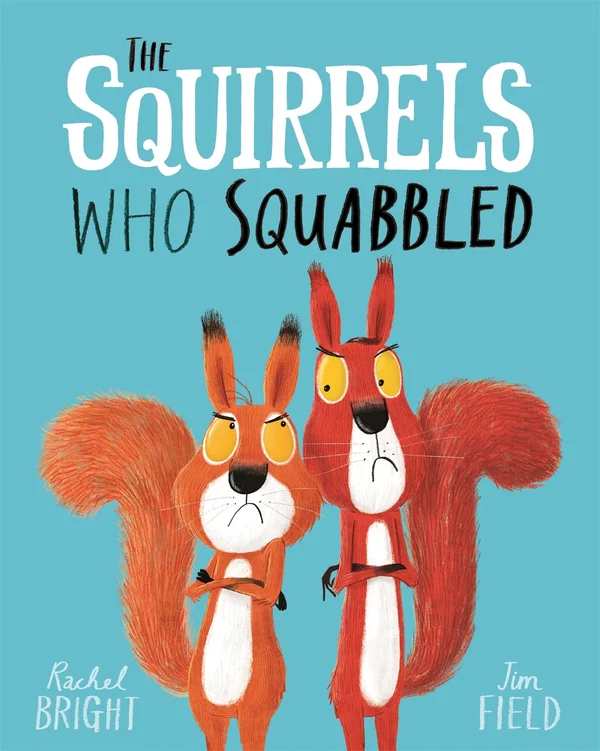
Cover of The Squirrels Who Squabbled
The Squirrels Who Squabbled
📚
Cooperation Pre-K & Kindergarten

Book Guide

The Squirrels Who Squabbled

A story that explores cooperation and opens a conversation with your child.

★★★★★ Loved by families
This book teaches: Cooperation. choosing the group over the self.

Before, During & After Reading

Guiding Questions for Parents.

Definition of Cooperation for 4 - 7 year olds: Cooperation happens when two or more people help each other to make something good happen. It can also apply to animals or parts of a whole that need each other and work together.  An example of this is the human body – all the parts work together to make you healthy. In a nutshell: Together we can do more.  Summary: As winter approaches, a lazy squirrel named Cyril fails to collect food while other forest animals responsibly work hard to gather enough for the cold months ahead. Bruce the squirrel, eager to complete his storage, encounters Cyril as they squabble over the last remaining pine cone. They suffer painful consequences of not working together, but manage to learn a lesson and become friends.    Lesson Objectives: 
  1. Students identify with the squirrels’ plight and talk about what Cyril and Bruce could have done differently to avoid the consequences of their arguments. 
  2. This lesson could be a segway to a science unit on forest animal behaviors and environmental responsibility to protect these animals so they have enough food and shelter to survive in tough times. 
  Guiding questions:   
  1. Why do squirrels have to collect food to store for winter? 
  2. Why do you think Cyril waited so long to collect food to store for winter? 
  3. Which squirrel do you think was more responsible? Why? 
  4. Why do you think Bruce and Cyril decided to become friends at the end of the story?
  5. Are there times when you’re really having fun and you don’t want to stop playing? 
  6. Do you have chores at home? If so, what are they? 
  7. Does this happen to you sometimes: you’re having so much fun playing that you don’t want to stop and do what your parents are asking you to do? 
  8. What if you’re not ready to go to bed but it’s bedtime, or it’s time to join your family and eat, but you don’t want to stop what you’re doing? Is it hard for you to cooperate? 
  9. Do you feel better when you cooperate with what you’re supposed to be doing, or better when you just do what you want to do and refuse to cooperate? 
  10.  Did you ever have a fight with another kid and then make up and become friends again? Tell us what happened? 
 
🌿   Virtue Connection: Cooperation means choosing to contribute to something larger than yourself.

Hands-On Practice

Activities for This Story.

Tree Homes: Squirrels

Activity: Students construct a large paper tree which becomes a “home” for squirrels. The teacher creates two paper bag puppet squirrels for role play activities. Each student is given a scarf to use for role play as the teacher guides them through squirrel activities.  
 

Materials needed: Materials to make a large paper oak tree with branches and leaves using brown and green paper, markers - [draw a large hole in the tree and glue a nest of paper scraps];  scarves, one for each student (ideally, brown, but any color will do); five acorns per student (or use paper ones - be sensitive to nut allergies); the script for the teacher guided activities; the book: “Squirrels Family Tree” (there’s a short summary below if you don’t have the book)
 

Script: One day, dad and mom squirrel tell their children they will learn how to gather and bury nuts. [use the paper bag squirrels to talk to the children] “Sometimes you will forget where you bury them, but that’s okay because those nuts will start to grow into new oak trees and provide food for new squirrel families. Now, when I call your name, get up and gather 5 nuts from the tree and come back and sit down. Put the nuts in front of you and pretend to dig holes for them with your front paws. [teacher can demonstrate how to do this] Put the nuts in the pretend holes and cover them with your scarf [dirt]. When I give a signal, take out 3 nuts and leave the rest. [wait until all have removed some]. Now what will happen to those that didn’t get eaten? [they will grow into trees] Is that a good thing? Yes!”
 

Directions: Display the tree with the parent squirrels on the wall. Remind students of the story the “Busy Tree” in which the tree provided homes and food for many animals. Read “Squirrels Family Tree” if you have a copy. If you don’t have this book, explain that squirrels and oak trees have a special relationship. They cooperate to keep each other alive. Squirrels collect the acorns from the oak tree, eat some and bury the rest. They often forget where they bury their nuts. Ask them what they think happens to those acorns? Describe how they grow into new trees that will provide food and shelter for future squirrel families. Explain: “Today we’ll learn about how a tree provides a home for a squirrel family. I’ve made a paper tree and posted it on the wall, with mother and father squirrel puppets on either side of a hole that has become their home. Inside the hole are twigs and straw [made of paper] that they use to make a nest. You will turn into squirrel children who live in this tree with your parents. Now you will each get some pretend dirt [a scarf] and some nuts. You can act out the story while I read.” Give each student a scarf and 5 paper nuts (or real ones if you have them). Use the squirrel puppets and read the script while students act it out as they sit in a circle on the floor. 
 

Wrap-up: “Squirrel families and oak trees are good friends, aren’t they? Can you explain how they help each other? [listen for responses] Let’s try to follow their example and help each other. Can you think of ways we could do that here at school? [listen for responses]

About the Story.

This guide is part of the Values & Virtues library, a free collection of 400+ book guides and activities organized around 12 core virtues for children from pre-K to 6th grade. Each guide includes Guiding Questions designed to open a real conversation with your child in 10 minutes or less.

Read-aloud video · Best with headphones
Find this book at your library or bookstore →

Explore more guides for Pre-K & Kindergarten.