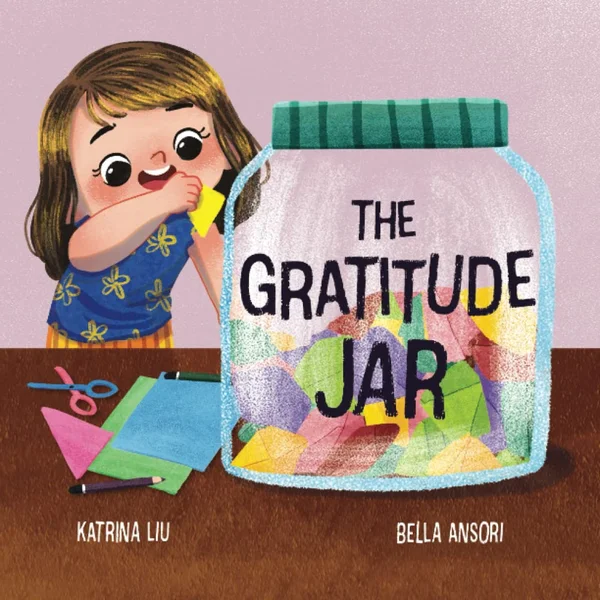
Cover of The Gratitude Jar
The Gratitude Jar
📚
Gratitude Pre-K & Kindergarten
By Katrina Liu

Book Guide

The Gratitude Jar

A story that explores gratitude and opens a conversation with your child.

★★★★★ Loved by families
This book teaches: Gratitude. noticing and appreciating what is already good.

Before, During & After Reading

Guiding Questions for Parents.

Definition: Someone who is grateful is thankful for people, nature, and things. Stewardship means taking good care of what we’ve been given. In short: Thankful for every blessing, big or small.   Summary: Mina struggles with a bad habit of complaining - she easily concludes that “it isn’t fair” when others have what she wants.  Her mom helps her by making a gratitude jar, “a special jar that reminds us of the good things in our lives.” At first Mina can’t think of any gratitudes, but with mom’s assistance, she discovers lots of reasons to be thankful.    Lesson Objectives: 
  1. Students are more inclined to notice the good things in their lives, and are likely to express gratitude more often. 
  2. Teachers can guide students to make their own gratitude jars to keep and use at school or take home and use with their families. 
  Guiding Questions: 
  1. Describe some of the reasons why Mina is so unhappy. 
  2. What does Mina say everytime she thinks about what others have that she wishes she had? Hint: It isn’t … (Fill in the blank)
  3. What does the word gratitude mean to you? 
  4. Describe what a gratitude jar is.  
  5. How does Mina decorate her gratitude jar? 
  6. Name three things for which Mina is grateful. Name three things for which you are grateful. 
  7. How does Mina’s family use the gratitude jar? 
  8. After Mina gets into the habit of sharing her gratitudes, how does she change?  
  9. How would you decorate your gratitude jar? Make one to share with your family. 
  10. Next time you feel like complaining, try to think about something for which you feel grateful and see if it makes you feel better. 
🌿   Virtue Connection: Gratitude means noticing and appreciating what is already good.

Hands-On Practice

Activities for This Story.

Activity:  Students will make a gratitude jar or box to take home to use it with their families.    Materials: medium size jars (one per student) or boxes (which may be easier to acquire and decorate) and one decorated large jar for the classroom; decorating materials, such as paint, colored pencils, glitter, construction paper, glue, etc.; small squares big enough for students to draw a picture or write a few words   Directions: Explain: “Today we will be making gratitude jars (or boxes), just like the one we read about. I have made a class gratitude jar that we can all use here at school. You will take your jar home with a note from me that explains how to use it, and some small papers on which everyone can write their gratitudes or draw pictures to show your gratitudes. You can encourage your family members to participate and write their own gratitudes, at least one per day, and put the notes in the jar. Pick a time with your parents to read the notes with the whole family.” Distribute the jars and advise students about decorating them. The class jar remains for an extension activity. Give 5 minutes of class time every day for two weeks (or longer) for students to write their gratitudes and put them in the class jar. Students who need it are given writing assistance. Teachers can provide a word wall with vocabulary that suits this assignment. Read or show (if it’s a picture) the gratitude messages to the whole class. Ask students to share about their experiences using their gratitude jars at home with their family.    Wrap it up: Explain that the purpose of this activity is to remind us to feel grateful for the many good things in our lives. It is also a chance for you to help your family to be more thankful by encouraging them to use the gratitude jar with you.

About the Story.

This guide is part of the Values & Virtues library, a free collection of 400+ book guides and activities organized around 12 core virtues for children from pre-K to 6th grade. Each guide includes Guiding Questions designed to open a real conversation with your child in 10 minutes or less.

Read-aloud video · Best with headphones
Find this book at your library or bookstore →

Explore more guides for Pre-K & Kindergarten.