Cover of Stone Soup
Stone Soup
📚
Cooperation 3rd & 4th Grade
By Marcia Brown

Book Guide

Stone Soup

A story that explores cooperation and opens a conversation with your child.

★★★★★ Loved by families
This book teaches: Cooperation. choosing the group over the self.

Before, During & After Reading

Guiding Questions for Parents

Definition of Cooperation for children for 8 - 11 year olds: Cooperation happens when we work together with a good attitude to achieve the same goal or accomplish a common task. Sometimes it involves being willing to compromise or give something up so that the task can get done. 

In a nutshell:

Together we can do more

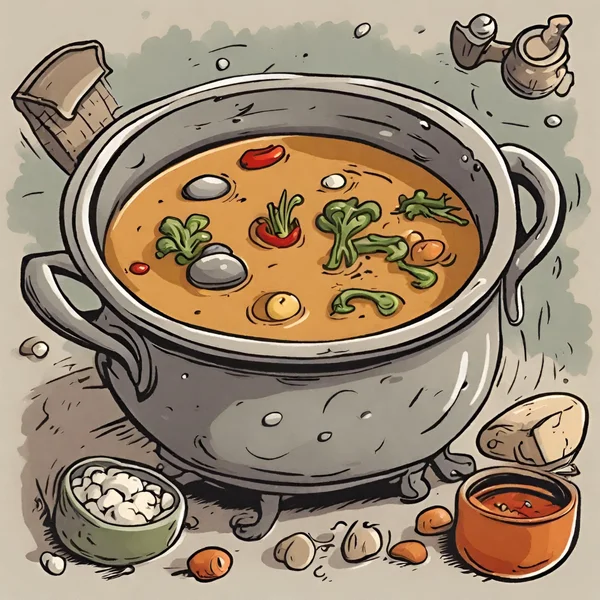
Summary: A couple of hungry travelers go door to door in a village asking for food, and everyone says they have nothing to give him. They devise a scheme to get the neighborhood involved in making what they call stone soup, which is nothing more than a stone placed in boiling water. They persuade villagers to look again for food at home to add to the soup, and everyone comes back with delicious ingredients. After tasting the delicious meat and vegetable soup, the villagers bid farewell to the travelers. Because everyone learned to share, they never go hungry again. 

Lesson Objectives 

  1. Students will recognize that when one person starts giving first, others are more willing to contribute and cooperate for the benefit of all. 
  2. Students will develop the desire to choose to set the standard and inspire others to cooperate,  instead of hesitating to be the first to give.

Guiding questions:

  1. Do you think the travelers were disappointed that no one would help them? 
  2. Why do you think the villagers wouldn’t give the hungry travelers any food at first? 
  3. What happened when the travelers started making the soup? 
  4. Why do you think the villagers changed their minds and brought ingredients for the soup? 
  5. In the end, were they happy they had decided to share? Why or why not? 
  6. What do you think the villagers learned from the travelers? 
  7. Did their visit change anything in the village? Why or why not? 
  8. Have you ever struggled to share something with someone? What happened? 
  9. How did you feel afterwards when you shared? When you didn’t share? 
  10. Have you ever been in a situation when you needed someone’s help and no one came to the rescue? What happened? How did you feel? 
🌿   Virtue Connection: Cooperation means choosing to contribute to something larger than yourself.

Hands-On Practice

Activities for This Story.

Materials needed: A big pot, a stone (washed), a burner for making soup, lots of prepped and washed vegetables in separate bowls: carrots, beans, potatoes, etc., broth (enough for the whole class), soup bowls and spoons

Directions: 

  • Divide the group into “families” of 3. Each family is assigned to make drawings of a vegetable. Family #1 makes carrots, Family #2 makes potatoes, and so on. The “families” are sitting at their desks and they have 5 minutes to draw.  
  • On a separate table is the “fire” (the burner) and the prepped and washed vegetables (prepared by teacher or parent helper).  
  • Assign one student to play the soldier. Explain that the teacher or a classmate will narrate the story, students will act it out as it's read. 
  • The soldier carries the pot into the “village” and the action begins. 
  • The narrator begins the story with the soldier’s entrance into the village, asking for food. The “villagers” hide their food at their desks and they all say they have no food to give the soldier. The soldier says he will make stone soup. He grabs a rock and puts it into his pot. The narrator calls the “families” to approach the soldier one “family” at a time. The soldier asks them if they have anything to add to the soup. Each family says, “No, we have nothing”, and they go back to their desks where the “food” is hidden. The soldier keeps stirring the pot with only the stone in it and says, “If only I had 3 carrots, I could make a soup the king would love.” The carrot “family” comes with the pictures of their carrots and they say, “We found some carrots in our garden, here!” One by one the “families” come with their pictures of ingredients for the soup, and throw them in the pot. Finally, all the ingredients have been added to the paper soup. The narrator finishes the drama by reading the rest of the story. 
  • Meanwhile, the real soup cooks, and the teacher guides a discussion, using the Guiding Questions in the Companion Content.
  • Everyone enjoys a bowl of soup at the end of the day. Soup takes a long time to cook, so plan on serving it later on in the day when it’s finished. 

Read-aloud video · Best with headphones
Find this book at your library or bookstore →

Explore more guides for 3rd & 4th Grade.