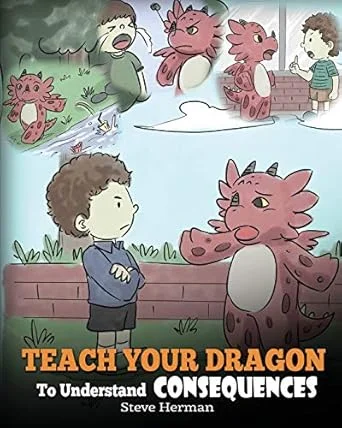
Cover of Teach Your Dragon To Understand Consequences
Teach Your Dragon To Understand Consequences
📚
Responsibility 1st & 2nd Grade

Book Guide

Teach Your Dragon To Understand Consequences

A story that explores responsibility and opens a conversation with your child.

★★★★★ Loved by families
This book teaches: Responsibility. owning your choices and their consequences.

Before, During & After Reading

Guiding Questions for Parents

Definition:

doing what needs to be done without complaining. 

In short:

Do what needs to be done.

Summary:
Drew’s pet dragon needs to learn how to do what’s right. Drew tells the story of his efforts to train his dragon in a poem. Poor Diggory has a lot to learn. He doesn’t like waiting his turn, he steals candy, skips homework, fails to clean up his messes, and throws trash on the ground. Finally, Drew explains to Diggory what the word “consequences” means and how it applies to Diggory’s irresponsible actions. Diggory begins to learn that, “when you choose to do what’s right, then good things will come your way!” 

Lesson Objectives: 

  1. Students practice pausing and asking themselves what the consequences could be for both good and irresponsible behaviors. This helps them make good choices. 

Guiding Questions: 

  1. What excuse did Diggory give to Drew when he spilled milk on the floor and didn’t clean it up? 
  2. When Diggory threw a candy wrapper on the ground, he made an excuse, what did he say? 
  3. Diggory doesn’t like to wait his turn. Do you think he’s going to make friends that way? Why or why not? 
  4. When Diggory stole some candy, he didn’t think it was a big deal. What excuse did he give for stealing? 
  5. Why did Diggory skip his homework? 
  6. What does the word “consequence” mean? 
  7. Drew asks Diggory to pause before acting impulsively. The next time you are about to do something you know isn’t kind or right, pause, and ask yourself what the consequences could be. Try this for a whole day, or even a week. Do you feel good about yourself when you’re able to be responsible? 
  8. What does “making an excuse” mean to you? Can you give an example from the story? From your own experience? 
  9. The next time you’re thinking about not cleaning up after yourself, or littering, ask yourself, what if everyone did that? Stop and imagine what it would be like. 
  10. Ask a family member about an experience they had when they had to face the consequences of an irresponsible action. What happened, and how did they feel about it? 
🌿   Virtue Connection: Responsibility means owning what is yours, including your choices.

Hands-On Practice

Activities for This Story.

🔒 Sign in to unlock this story's hands-on activity.

Sign In to Unlock

About the Story

Drew’s pet dragon needs to learn how to do what’s right. Drew tells the story of his efforts to train his dragon in a poem. Poor Diggory has a lot to learn. He doesn’t like waiting his turn, he steals candy, skips homework, fails to clean up his messes, and throws trash on the ground. Finally, Drew explains to Diggory what the word “consequences” means and how it applies to Diggory’s irresponsible actions. Diggory begins to learn that, “when you choose to do what’s right, then good things will come your way!”

Read-aloud video · Best with headphones
Find this book at your library or bookstore →

Explore more guides for 1st & 2nd Grade.