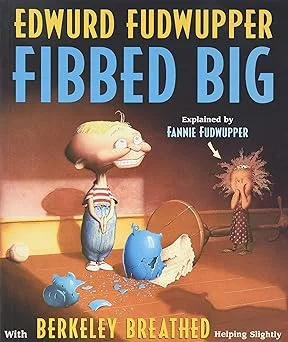
Cover of Edwurd Fudwupper Fibbed Big
Edwurd Fudwupper Fibbed Big
📚
Responsibility 1st & 2nd Grade

Book Guide

Edwurd Fudwupper Fibbed Big

A story that explores responsibility and opens a conversation with your child.

★★★★★ Loved by families
This book teaches: Responsibility. owning your choices and their consequences.

Before, During & After Reading

Guiding Questions for Parents.

Definition: doing what needs to be done without complaining.    In short: Do what needs to be done.

Summary: A girl begins to share a story of her older brother, Edwurd Fudwupper, who tells lots of big, fantastic fibs. His whopper lies create a lot of confusion. Eventually his innocent sister takes the blame in an effort to save him. Brother finally takes responsibility, recognizes his mistakes, and confesses. Sister and brother form a new bond of respect and love for one another.    Lesson Objectives: 
  1. Students discuss the link between honesty and responsibility and are encouraged to remember this tale when faced with the temptation to be dishonest. They brainstorm and create signs that encourage the action of taking responsibility to be honest. 
  Guiding Questions: 
  1. Who is telling this story? 
  2. What was the fib he told Mabel Dill? 
  3. What is the relationship between brother and sister in the beginning of this story? 
  4. What did Edward do to his mother’s vase, and what lie did he make up to try to cover his mistake? 
  5. What was the result of Edward’s lie about the broken vase? 
  6. When a lie is told it can get bigger and bigger and make all kinds of trouble. What were the consequences of Edward’s lie to Mabel Dill? 
  7. Why do you think Edward’s sister tried to protect him, even though he was mean to her? 
  8. We are responsible to be honest and tell the truth. Why do you think this is important? 
  9. Can you remember a time when you were tempted to lie and you decided to tell the truth instead? What happened? 
  10. Can you remember a time when you were tempted to lie and you lied? How did you feel about that and did anyone ever discover the truth? What happened? 
 
🌿   Virtue Connection: Responsibility means owning what is yours, including your choices.

Hands-On Practice

Activities for This Story.


Activity: Students watch and discuss the video, especially the themes of honesty and responsibility. They discuss lying, fibbing, making up false stories, and why this kind of behavior is hurtful. Students also talk about what it means to be honest - when we’re honest we are also responsible and trustworthy. They do an activity that links these three virtues and they practice this statement, “when I am honest, I am responsible and trustworthy.” And this one:  “The more honest and responsible I am, the more I will be trusted.”
 

Materials needed: the video;  3 strips of blank paper - around 8 “ in length, 3 “width; writing and decorating materials; a designated space in the classroom for making a “wall of bricks”; an adhesive to stick the bricks to the wall
 

Directions: Show the video and lead a discussion with open-ended questions on why lying, fibbing, and making up false stories is hurtful. Ask students about why a person who tells the truth, who doesn’t lie, fib, or make up false stories is someone who can be trusted. Discuss the idea of why it’s good to be a trustworthy person. Explain that someone who is trustworthy is respected by others and given responsibility and opportunities to do important tasks. Introduce the activity of making a solid wall of “bricks” - “The Trustworthy wall”. Each student is given 3 paper bricks. They write one sentence on each brick: “I am honest”, “I am responsible”, and “I am trustworthy” and their name on each brick. Students bring up their “I am honest” bricks first to make the bottom layer of the wall, and place them side by side with an adhesive. This is followed by a second layer of the “I am responsible” bricks. Finally they add the last bricks. Explain that the wall represents how a person becomes trustworthy when they are honest and responsible. It is strong and sturdy, and so are we when we practice these virtues. Students can add a stick figure drawing of themselves that can be placed at the top of the wall to represent the goal of becoming a trustworthy person.
 

Wrap it up: Explain why you had them do this activity - you want to encourage them to work towards being a trustworthy person by being honest and responsible. Add suggestions for any specific actions they can do in the classroom to show that they are being honest, responsible, and  “building their own wall of trust”. 
 

About the Story.

This guide is part of the Values & Virtues library, a free collection of 400+ book guides and activities organized around 12 core virtues for children from pre-K to 6th grade. Each guide includes Guiding Questions designed to open a real conversation with your child in 10 minutes or less.

Read-aloud video · Best with headphones
Find this book at your library or bookstore →

Explore more guides for 1st & 2nd Grade.