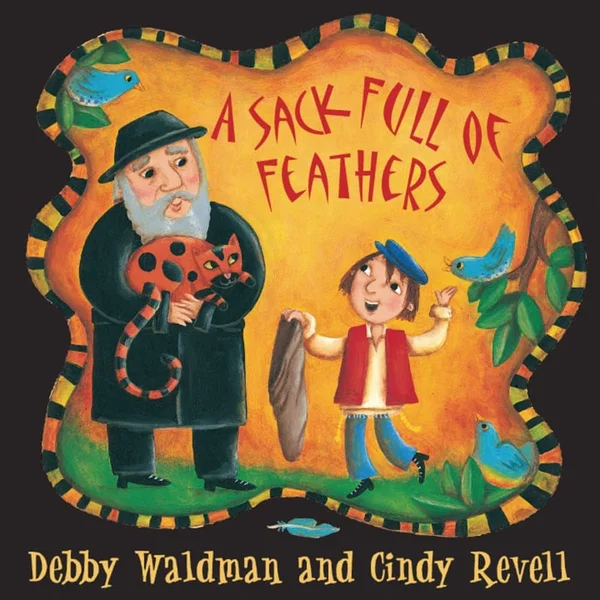
Cover of A Sack full of feathers
A Sack full of feathers
📚
Responsibility 3rd & 4th Grade
By Debby Waldman

Book Guide

A Sack full of feathers

A story that explores responsibility and opens a conversation with your child.

★★★★★ Loved by families
This book teaches: Responsibility. owning your choices and their consequences.

Before, During & After Reading

Guiding Questions for Parents.

Definition: doing what needs to be done with sincerity and without resistance or complaining.  In short: Do what needs to be done. Summary: Yankel learns an important lesson from his Rabbi when he gets into trouble for gossiping about people in his village. He makes the mistake of listening to others and leaving before he knows the whole story. What he shares with his friends are incomplete stories, and this misinformation gets him into trouble. The Rabbi finds out and he gives Yankel a strange task, to put a feather on everyone’s doorstep. As Yankel attempts to carry out the task, he encounters angry neighbors who are suspicious of his efforts. Finally Yankel gets distracted and the wind scatters the feathers. When he returns to the Rabbi with an empty sack, he is told to go find all the feathers. His attempts are unsuccessful. The Rabbi wisely educates Yankel about the negative effects of telling hurtful stories that are impossible to take back. Once told, these stories, like the feathers, are impossible to collect after they’ve been cast about in the wind.    Lesson Objectives:
  1. Students will be more careful about gossiping and telling half-truths, realizing that this will just make trouble for themselves and those featured in their stories. 
  Guiding Questions: 
  1. Yankel loved to tell stories about people in his village, but he  shared information that wasn’t his to share and also, it was often incorrect. This is called gossiping. Why is gossiping hurtful? 
  2. Describe the part of the story the baker told that Yankel heard. What part of the story did he not hear? 
  3. Yankel saw two ladies “fighting like cats” and quickly left to tell his friends about them. What part of this story did he not observe? 
  4. Why do you think Yankel likes to gossip with his friends? 
  5. Do you think people should be upset with Yankel or not?  
  6. How did the Rabbi know about Yankel’s habit of gossiping? 
  7. What do you think Yankel could have done to show he was sorry for spreading gossip? 
  8. The phrase, “talking behind my back” means that someone was gossiping about you. If that happened to you, how did it make you feel?  
  9. Would you be upset if someone made up a story about you that wasn’t true and told it to your friends? 
  10. Can you collect feathers that have been blown here and there by the wind? Can you take back words that you have spoken, even if you really, really want to? 
 
🌿   Virtue Connection: Responsibility means owning what is yours, including your choices.

About the Story.

This guide is part of the Values & Virtues library, a free collection of 400+ book guides and activities organized around 12 core virtues for children from pre-K to 6th grade. Each guide includes Guiding Questions designed to open a real conversation with your child in 10 minutes or less.

Read-aloud video · Best with headphones
Find this book at your library or bookstore →

Explore more guides for 3rd & 4th Grade.